Climate Change and Health Knowledge Platform for Research and Decision-Making in Bangladesh
Project Overview
Understanding the growing effects of climate change on public health requires access to reliable environmental, health, and population data. In Bangladesh, relevant information was spread across different institutions, publications, and data sources, making it difficult for researchers and program managers to access and use it efficiently.
We developed a centralized web-based resource platform for icddr,b’s Initiative for Climate Change and Health. Developed under the USAID-supported Research for Decision Makers (RDM) Activity, the platform brings together scientific knowledge, relevant data sources, publications, and interactive visualizations.
The website supports researchers, health professionals, program managers, and policymakers in understanding climate-related health risks and accessing information to inform research, planning, and intervention design.
The Challenge
Climate change affects health through multiple interconnected pathways, including extreme heat, air pollution, water contamination, food insecurity, and changing patterns of infectious diseases.
However, the information required to understand these relationships were distributed across separate sources. Users needed to navigate institutional websites, research publications, and environmental datasets to build a comprehensive picture of climate change and its health implications.
Presenting frequently updated environmental measurements alongside scientific explanations created an additional challenge. The platform needed to make complex information accessible while supporting exploration of both Bangladesh-specific and global climate trends.
The Solution
We developed a centralized knowledge and data visualization website that connects climate information, health-related resources, scientific publications, and environmental monitoring within a single platform.
The solution combines organized thematic content with interactive graphs and integrated environmental measurements. Users can explore climate-related health threats, access relevant data sources, and examine environmental trends through a unified web interface.
The integrated solution covers:
- Climate Change and Health Knowledge Hub – structured scientific explanations and resources describing the direct and indirect effects of climate change on health.
- Climate-Related Health Threats – information on dengue, malaria, kala-azar, chikungunya, heat stress, air pollution-related conditions, water-borne diseases, and nutrition risks.
- Climate Disaster Resources – information on floods, cyclones, droughts, and their implications for health and communities.
- Local and Global Climate Factors – resources covering temperature trends, rainfall, humidity, sea-level rise, salinity, greenhouse gases, and major climate phenomena.
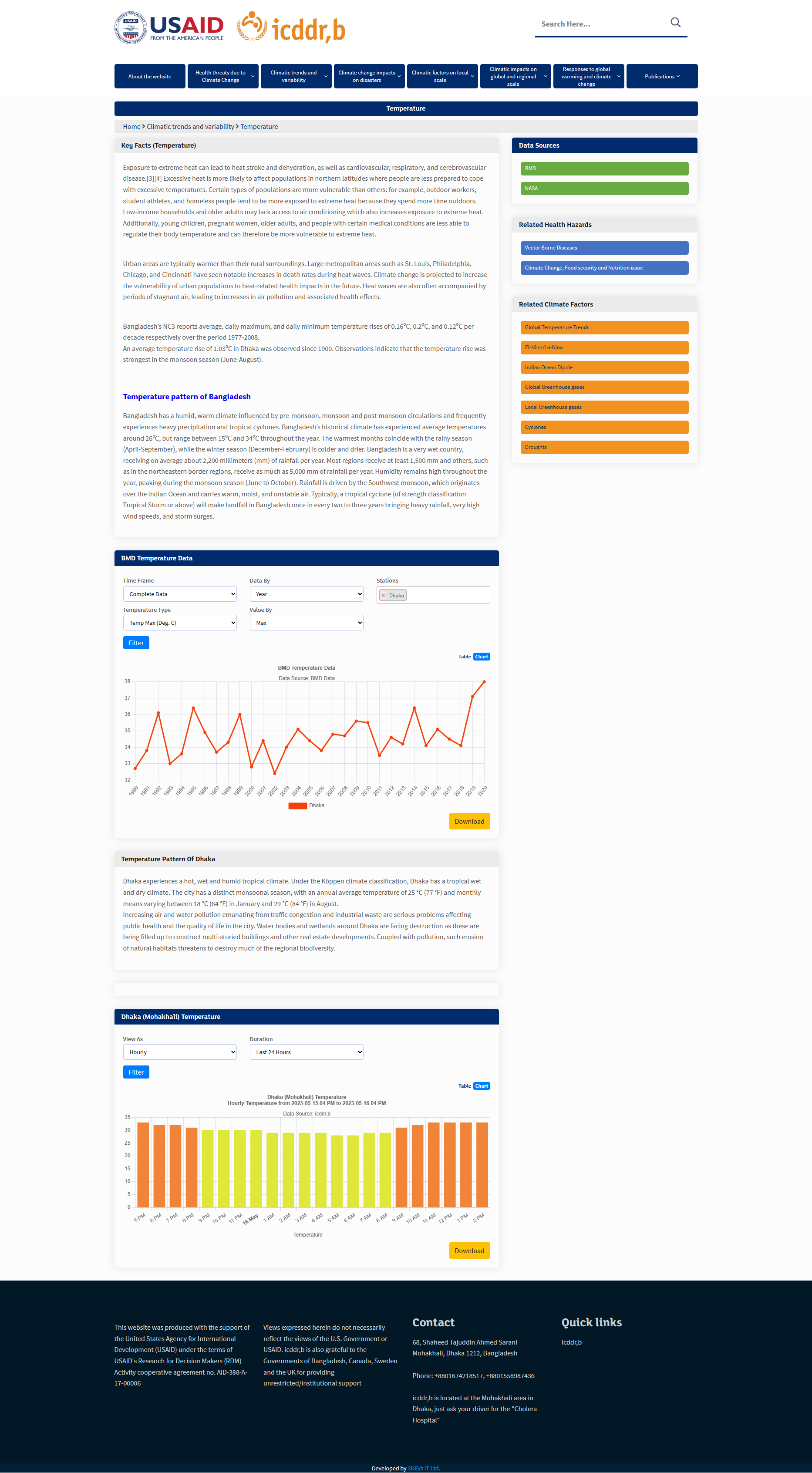
- Environmental Device Integration – integration with an outdoor IQAir device installed in Mohakhali to present locally recorded temperature, humidity, and air pollution measurements.
- Interactive Environmental Visualizations – graphs enabling users to explore hourly, daily, and monthly environmental measurements.
- Meteorological Data Visualization – dynamic graphs based on climatic parameters collected from the Bangladesh Meteorological Department.
- Health Data Presentation – presentation of selected disease-related information and visualizations to support exploration of climate-sensitive health issues.
- Knowledge Repository – access to scientific publications, knowledge briefing papers, and relevant institutional resources.
- Research and Institutional Links – organized access to external data sources and reference materials relevant to climate change and health research.
Technical Approach
- Centralized Information Structure – the website organizes climate, health, disaster, and research content into thematic sections, helping users navigate related information.
- Device-Integrated Environmental Monitoring – the platform incorporates measurements from an outdoor monitoring device, connecting locally observed environmental conditions with web-based information access.
- Time-Based Data Exploration – environmental measurements are presented across hourly, daily, and monthly views to support exploration of short-term changes and longer-term patterns.
- Interactive and Dynamic Graphs – visualizations make environmental and meteorological datasets easier to explore and interpret.
- Multi-Source Information Consolidation – the platform brings together scientific explanations, institutional references, publications, and selected datasets within a common interface.
- Connected Knowledge and Data – supporting explanations and references provide context for the visualizations, helping users understand the information they are viewing.
Key benefits include:
- Centralized access to climate change and health resources
- Easier discovery of relevant scientific publications and data sources
- Access to locally recorded environmental measurements
- Interactive exploration of temperature, humidity, and air pollution patterns
- Clearer presentation of meteorological and selected health data
- Access to both Bangladesh-specific and global climate information
- Better understanding of climate-related health threats
- Support for research, program planning, and intervention design
- A shared reference resource for researchers, health professionals, and policymakers
- A foundation for continued knowledge sharing and future resource expansion
Conclusion
The Climate Change and Health platform demonstrates how a centralized digital resource can connect scientific knowledge, environmental monitoring, and interactive data visualization to support public health research.
By bringing relevant information into a single web-based platform, the solution helps researchers, program managers, and policymakers explore climate-related health risks and access resources for informed planning and decision-making.